Relevant pool type experience, responsible people, service area, recent projects, and independently checked references.
Loading the evidence lab…
Loading the evidence lab…
PLAN THE PROJECT BEFORE THE SHORTLIST
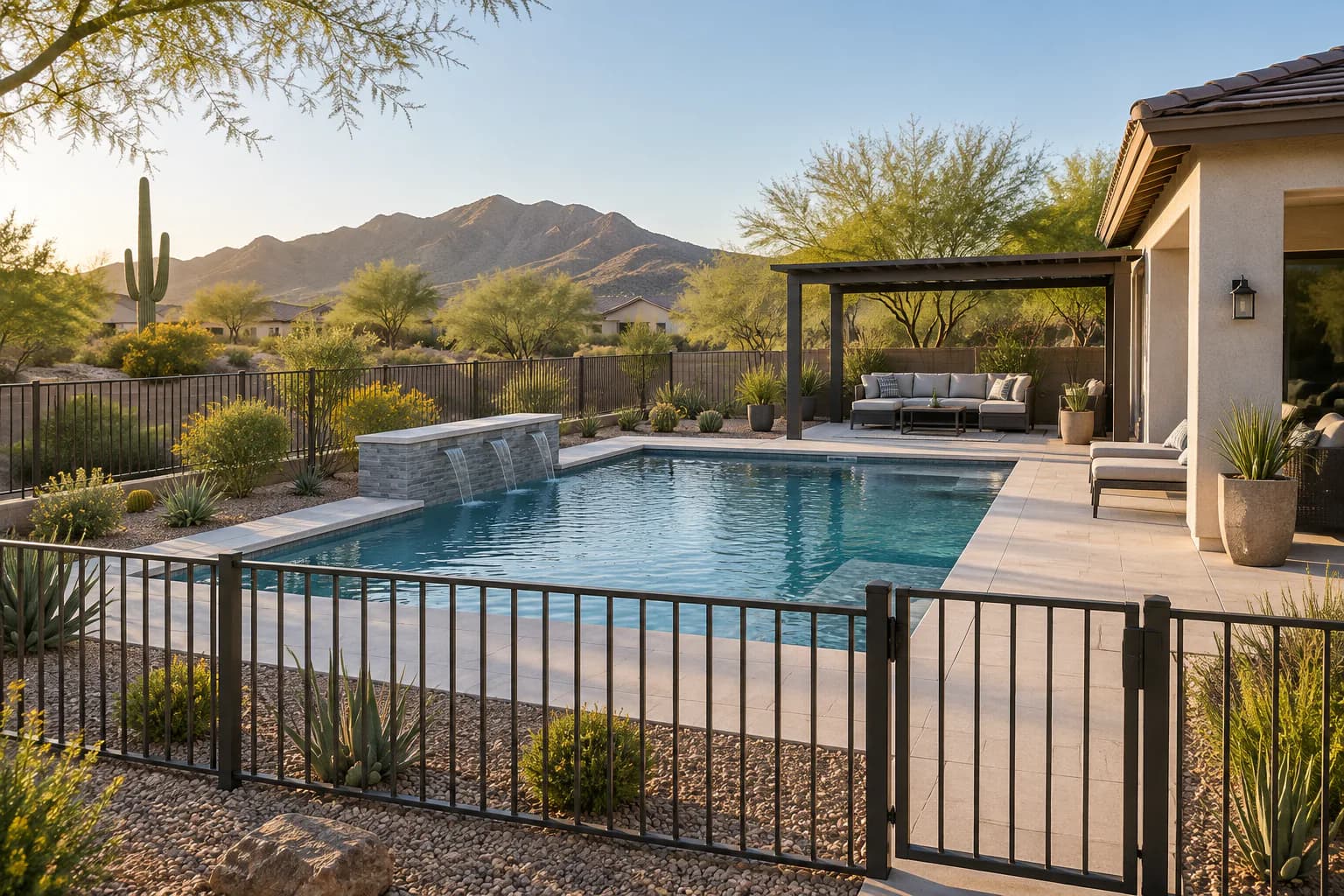
In the Phoenix and Tucson regions, a pool plan often works better when shade, deck exposure, seating, equipment ventilation, and water management are considered with the pool shape rather than added later. A compact geometric pool may preserve room for covered dining or play, while a plunge pool may suit a smaller lot. Waterfalls and other aerating features can increase evaporation, so ask what their operating schedule and water effect mean for the property. Northern and higher-elevation parts of Arizona can have different seasonal and freeze considerations; require site-specific design rather than a single statewide specification.
LOCAL RESEARCH BRIEF
Tempe, AZ pool planning should connect local property evidence, the responsible approval authority, climate and seasonal operation, complete project scope, and direct Pool Builder verification. Low-desert Phoenix and Tucson differ from higher-elevation northern communities in freeze exposure, season, and site conditions.
Relevant pool type experience, responsible people, service area, recent projects, and independently checked references.
The authority, required submissions, inspection stages, barriers, electrical work, and closeout evidence for the property.
Pool builders · Pool repair · Pool cleaning · Pool remodeling
These national resources do not replace the responsible state, county, or city authority.
Arizona Registrar of Contractors: Online Services ↗Arizona Department of Water Resources: Conservation Technologies ↗US Census Bureau: 2025 city population source ↗US Census Bureau: 2025 Gazetteer Files ↗Arizona state and local government contacts ↗NOAA-supported State Climate Summaries ↗FEMA Flood Map Service Center ↗CPSC Pool Safely ↗Find the state consumer protection office ↗Review CPSC residential pool barrier guidance ↗Read EPA WaterSense pool efficiency guidance ↗POOL BUILDERS
Confirm service area, legal identity, current details, qualifications, and project fit directly.
Coral Pools, Inc. is a pool construction and pool repair business in Tempe, Arizona. The listed business address is 1710 W 10th Pl, Tempe, AZ 85281. For enquiries about pool construction and pool repair, call Coral Pools, Inc. on +1 480-831-7932.
Pool builders · Pool repair
Keywize Pool Professionals is a pool construction and pool repair business in Tempe, Arizona. The listed business address is 2450 W 12th St #4, Tempe, AZ 85281. For enquiries about pool construction and pool repair, call Keywize Pool Professionals on +1 602-368-7256.
Pool builders · Pool repair
Poco Verde Pools and Landscape, Inc is a pool construction business in Tempe, Arizona. The listed business address is 520 W Warner Rd, Tempe, AZ 85284. For enquiries about pool construction, call Poco Verde Pools and Landscape, Inc on +1 480-893-3948.
Pool builders
Salten Pools - Pool Builders & Contractors | Swimming Pool Care & Remodeling Services in Arizona is a pool construction, pool cleaning, pool remodeling, and pool repair business in Tempe, Arizona. The listed business address is 1220 W Alameda Dr #101, Tempe, AZ 85282. For enquiries about pool construction, pool cleaning, pool remodeling, and pool repair, call Salten Pools - Pool Builders & Contractors | Swimming Pool Care & Remodeling Services in Arizona on +1 602-598-1717.
Pool builders · Pool cleaning · Pool remodeling · Pool repair
True Blue Pools is a pool construction business in Tempe, Arizona. The listed business address is 5235 S Kyrene Rd #102, Tempe, AZ 85283. For enquiries about pool construction, call True Blue Pools on +1 480-820-9495.
Pool builders
Valley Pool Remodel is a pool construction and pool remodeling business in Tempe, Arizona. The listed business address is 2010 E University Dr #18, Tempe, AZ 85281. For enquiries about pool construction and pool remodeling, call Valley Pool Remodel on +1 480-590-1667.
Pool builders · Pool remodeling
LOCAL DESIGN AND OWNERSHIP DECISIONS
Concrete or gunite can support custom shapes, integrated spas, shelves, and complex grades, while fiberglass offers a factory-made shell with dimensions that must fit the excavation route and crane or delivery plan. Vinyl-liner and above-ground options create different site, deck, replacement, and warranty questions. Ask every Pool Builder to identify the proposed structure, engineering basis, interior finish, coping, deck material, expansion details, drainage route, and assumptions about soil, rock, utilities, access, and spoil removal.
The proposal should name the pump, filter, sanitation approach, automation, lighting, cleaner, fill control, overflow route, and leak-detection strategy rather than using a generic equipment-package label. Compare cartridge and backwashing requirements, cover options, expected service access, noise near bedrooms or neighbors, and who programs the system at startup. If a proposal names Pentair, Hayward, Jandy, or another manufacturer, verify the exact model, installer responsibilities, registration process, and separate product and workmanship warranty routes.
The responsible city, town, or county—not the statewide Pool Builder page—determines the project review path. Ask who prepares drawings, submits the permit, answers corrections, schedules inspections, coordinates electrical work, and documents the final barrier and gate arrangement. Setbacks, easements, utility conflicts, grading, and neighborhood rules can change a design after an attractive concept has been chosen. The quote should state which investigations are included and how an unresolved condition becomes a written change.
Closeout should include startup responsibilities, initial water-care instructions, equipment settings, manuals, model and serial numbers, registrations, finish-care requirements, and the route for reporting a leak or workmanship concern. Ask how hot-weather scheduling affects excavation, concrete or finish work, landscaping, and owner decisions without accepting a guaranteed completion date unsupported by permits, site information, material availability, and inspection timing.
The directory's Census-sourced 2025 population record lists 190,571 residents. Using the Census Gazetteer land-area figure, the municipal average is approximately 4,768 residents per square mile, indicating a compact urban pattern. These citywide measures do not describe an individual lot, household, budget, or preference; they simply make access, space allocation, shared boundaries, and compact-pool options reasonable early questions. Low-desert Phoenix and Tucson differ from higher-elevation northern communities in freeze exposure, season, and site conditions. Ask which survey, utility, access, grade, drainage, soil, groundwater, tree, easement, and neighboring-property information supports the concept. Mark every unconfirmed condition as an assumption or investigation item rather than allowing a familiar local pattern to become an unsupported parcel-level claim.
Concrete or gunite can support custom geometry, integrated spas, ledges, and complex site relationships, but the proposal must explain structural design, curing, finish, startup, and future resurfacing. Fiberglass uses a factory-made shell whose exact dimensions, delivery route, base, backfill, groundwater response, and deck interface matter. Vinyl-liner pools add liner measurement, care, and replacement planning. Above-ground or semi-inground systems require compatible walls, supports, decks, access, and manufacturer instructions. Plunge and lap pools describe use and proportions; saltwater describes a sanitation approach; infinity edges and pool-spa combinations are features with separate structural, hydraulic, equipment, energy, and maintenance consequences.
Long periods of heat can extend use, while intense sun, evaporation, monsoon runoff, and elevation-dependent freezes affect design and operation. The useful question is not whether a generic climate claim is true somewhere in the region, but how the proposed pool will be used and protected on this property. Define the desired swimming season, target water temperature, daily operating pattern, cover use, shade, wind, debris, heating or cooling, severe-weather procedures, winterization where applicable, and recommissioning. Request exact equipment and written assumptions behind performance expectations; avoid guaranteed seasons or operating costs that are not supported by the design and utility information.
Shade, hot surfaces, water management, equipment ventilation, rock or expansive soils, and measured excavation access deserve written assumptions. Require measured gate and side-yard clearances, overhead and underground constraints, excavation and delivery routes, staging, spoil handling, temporary protection, and restoration. Ask what geotechnical, structural, groundwater, flood, grading, or drainage information is required and who supplies it. Show finished levels, pool overflow, deck drainage, equipment drainage, retaining interfaces, and affected yard runoff on coordinated documents. FEMA mapping is a research starting point, not a substitute for elevation data, local review, engineering, or property-specific flood advice.
Begin by confirming whether the parcel is actually inside Tempe's municipal jurisdiction or handled by a county or another authority. Ask for the current building, planning or zoning, electrical, plumbing, grading, stormwater, and inspection path that applies to the exact address. Record who prepares and submits plans, pays fees, answers corrections, schedules inspections, and supplies closeout evidence. Confirm setbacks, easements, barriers, gates, dwelling-door or window interfaces, electrical bonding and grounding, plumbing, gas, energy, drainage, and trade qualifications with the responsible authority. CPSC guidance is useful national safety education, not a replacement for adopted local requirements. HOA or architectural approval is a separate private process and never substitutes for government approval.
A credible Tempe, AZ budget starts with comparable written scopes, not a national headline price presented as local fact. Separate design, survey, engineering, permits, excavation, access, hauling, structure or shell, plumbing, equipment, electrical and gas work, finish, coping, deck, drainage, barriers, landscaping, irrigation, restoration, startup, tax, allowances, and owner-supplied work. For rock, groundwater, unsuitable material, utilities, or other unknowns, record the investigation, assumed condition, measurement method, evidence, price basis, authorization, and schedule effect. Compare ongoing electricity or fuel, water, chemicals, cleaning, service, cover care, seasonal work, repairs, and component replacement using the actual design.
Give every candidate the same project brief and ask for the same work-package schedule. Verify the exact legal entity, current credentials where required, insurance evidence, responsible people, relevant and recent projects, references, service area, and capacity for the proposed system and site. Normalize inclusions, exclusions, quantities, models, allowances, substitutions, payment milestones, schedule dependencies, change procedure, inspections, commissioning, punch work, and warranties. Appearance on this site does not verify any capability, credential, availability, review history, or service boundary.
Require manufacturer, model, capacity, controls, electrical or fuel needs, installation responsibility, registration, and warranty for pumps, filters, sanitation, heaters, cleaners, lights, covers, fill controls, sensors, and automation. A saltwater pool commonly uses a chlorine generator; it is not a distinct structural pool type or chlorine-free system. Check materials, water balance, cell care, replacement, and warranty conditions. Commission every operating mode and transfer baseline settings, manuals, secure account ownership, model and serial numbers, and product-support routes.
The usable result includes movement around the water, seating, shade, visibility, storage, service access, deck transitions, planting, drainage, and safe access—not only the pool shell. On compact or dense sites, test plunge pools, lap-oriented proportions, reduced deck areas, equipment noise, crane or excavation access, and preservation of other yard functions. On larger sites, long utility runs, grading, drainage, retaining, landscape restoration, and supervision distances may become more important. Do not infer budget or desired features from population or neighborhood statistics.
Closeout should identify approvals, inspection outcomes, approved changes, product details, models and serial numbers, registrations, startup readings, baseline settings, finish-care instructions, manuals, warranties, photographs, and support contacts. Set responsibility for initial water care, training, punch-list closure, winterization or storm preparation where relevant, and warranty diagnosis. Keep a dated maintenance record covering water observations and tests, cleaning, chemical additions, filter pressure, equipment settings, alarms, leaks, service visits, repairs, and claim correspondence.
LOCAL REVIEW RESEARCH
Do available examples and reviews describe the same pool system, scope, site conditions, and service type?
How current are the projects, reviews, references, credentials, and operating processes?
Which themes repeat across independent sources, and which are vague or isolated?
Which business, credential, insurance, product, proposal, and warranty claims can be checked?
What must be clarified in the proposal and written agreement before signing?
RELATED LOCAL PAGES
FROM RESEARCH TO DECISION
Separate useful project evidence from emotion, popularity, recency bias, and unsupported claims when researching a pool contractor.
Read guide →VerificationCheck business identity, credentials, insurance evidence, project examples, references, products, and warranty statements at their source.
Read guide →HiringRun structured reference checks that verify comparable project experience, communication, changes, closeout, and post-project support without treating one enthusiastic customer as proof.
Read guide →Decision toolsCompare candidates across evidence quality, relevant work, proposal completeness, project controls, communication, closeout, and unresolved risk.
Read guide →HiringInterview every candidate about relevant work, site investigation, scope, people, changes, inspections, commissioning, and warranty responsibility.
Read guide →VerificationIdentify the responsible permit authority, required submissions, inspection stages, closeout records, and contractor responsibilities before pool construction begins.
Read guide →Project controlDocument access, utilities, excavation assumptions, water management, finished levels, spoil, restoration, and unknown-condition procedures before work starts.
Read guide →